
 A new survey presented at the Legal Marketing Association Annual Conference confirms that general counsel and business leaders are actively consuming law firm thought leadership content but are highly selective about what earns their attention and trust. The findings show that in-house counsel value timely, business-focused legal insight that’s clear, actionable and easy to share internally.
More than 82% of in-house counsel surveyed by JD Supra and Limelight said they consume thought leadership content from outside law firms at least weekly, while 45% say they engage with it daily.
Respondents said they especially value content from outside law firms and lawyers that helps assess legal risk or compliance exposure, explains how developments affect their company or industry and provides actionable guidance.
This is why law firms and lawyers who partner with experienced legal marketing writers can make a measurable difference. To these partnerships, attorneys bring substantive legal knowledge, while legal communicators shape that knowledge into content that business leaders can quickly absorb and apply.
The survey’s findings were shared at the Legal Marketing Association’s Annual Conference in March 2026. “Trust, Relevance, & AI in 2026: What GCs Want from Law Firm Thought Leadership,” offers valuable insights from in-house and general counsel for law firms and lawyers who produce content as part of their marketing and business development strategy. 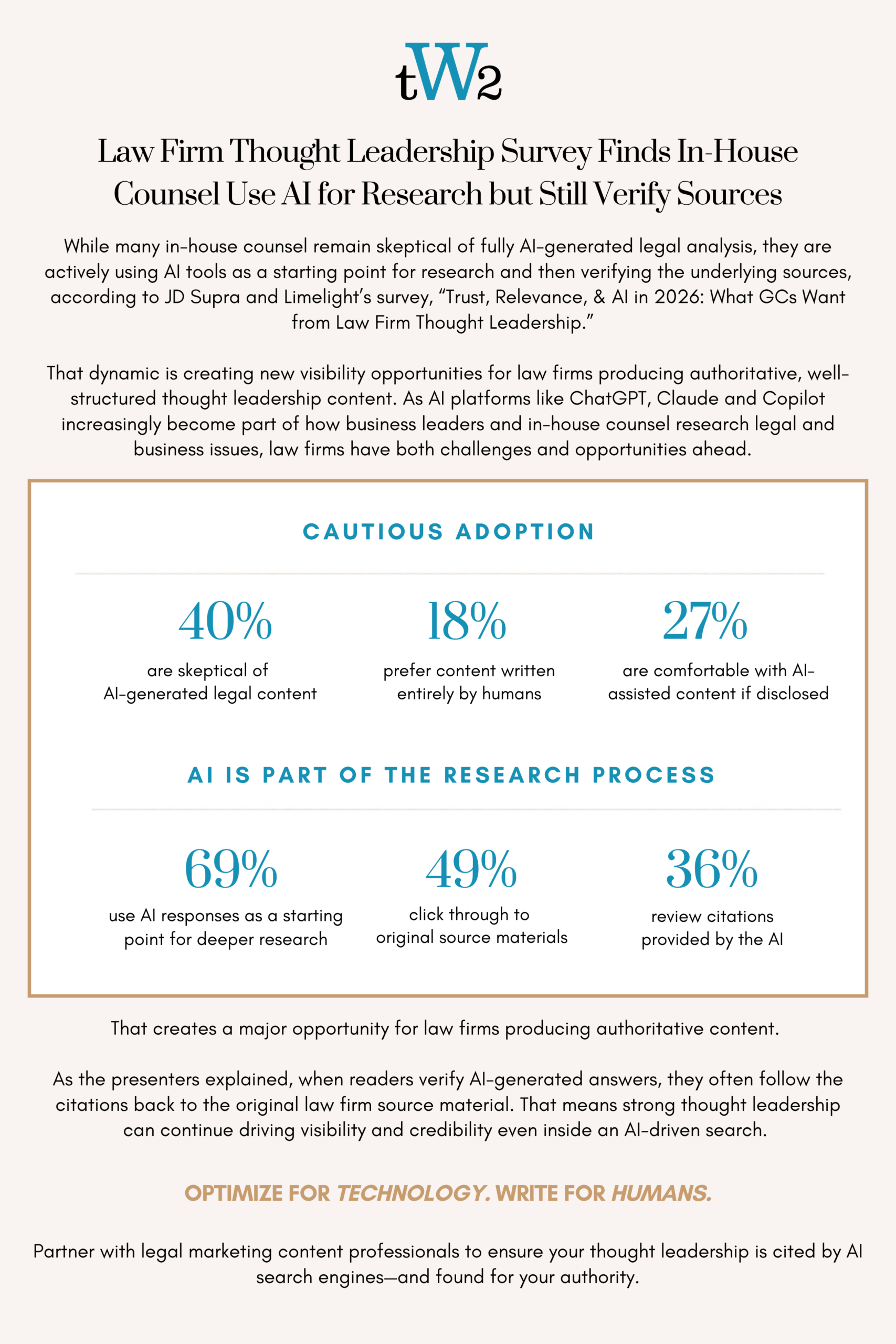
The survey organizers were joined by general counsel to present the findings. The main takeaway from the data, the presenters agreed, is clear: Thought leadership isn’t about publishing more content; it’s about delivering insights that help business leaders understand risk, make informed decisions and solve problems.
That, they said, requires content that quickly demonstrates:
- Relevance to the reader’s business and industry
- Clear insight
- Respect for the reader’s time
As Cox Media Group Executive Vice President and General Counsel Eric Dodson Greenberg noted during the discussion, in-house counsel rarely deal with legal questions “in the abstract.” General counsel are constantly translating legal developments into operational, financial and strategic guidance for leadership teams, he said. Content that frames legal developments in a meaningful business context immediately becomes more valuable.
“Know My Business” is the Real Differentiator
The survey respondents were remarkably consistent about what they think makes law firm thought leadership trustworthy. The top drivers included:
- Clarity of insight and writing (75%)
- Depth of knowledge about the reader’s industry sector (62%)
- Transparency about complexity and nuance (56%)
The Biggest Problems with Law Firm Content
The survey also identified what readers dislike most about law firm thought leadership:
- Feels self-promotional
- Does not answer questions quickly
- Is too long or unfocused
- Repeats information already available elsewhere
During the panel discussion, the speakers emphasized that the best legal content gets to the point quickly and explains why the issue matters. Look at how news articles are written with the most important information in the first few sentences, they said, and mimic that.
Also, avoid legalese. The presentation described using the “flip it test”: Could the recipient forward the article to a business executive who isn’t a lawyer and have them immediately understand the implications? If the answer is no, the content likely needs stronger structure, clearer language and more practical framing.
This is increasingly important because legal thought leadership is often circulated within organizations. Clear, concise and business-oriented content travels faster and farther.
Thought Leadership Supports Business Development Even Without an Immediate Call
One of the most important themes from the discussion was that thought leadership works cumulatively. Readers rarely finish an article and immediately hire a lawyer. But valuable content contributes to familiarity, credibility and long-term trust.
The survey’s data reinforces this:
- 27% of respondents said they hired a law firm because of its thought leadership
- 34% said thought leadership helped a firm stand out from competitors
Following a thought leadership read, the more common next steps for those surveyed included:
- Saving the content
- Forwarding it internally
- Subscribing for future updates
- Following the author on LinkedIn
- Adding the firm to a future consideration list
Greenberg referred to this as “stacking credibility.” Each useful alert, webinar or article reinforces the perception that the attorney understands the industry and stays ahead of developments.
That relationship-building dynamic matters because legal hiring decisions are rarely based on a single interaction. Thought leadership becomes one factor among many in the broader trust-building process.
Why Speed and Timing Matter More Than Ever
The panel also discussed the growing pressure for firms to respond quickly to breaking developments. Greenberg said, “Being first matters.” When a major decision or regulatory development happens, clients often read the first credible summary they receive.
CLOC President and CEO Oyango Snell gave this advice: “Don’t let perfection equal paralysis.” In other words, get the update written and distributed even if it’s short and incomplete — then follow it up later (soon) with more analysis. The survey shows that the best-performing content combines timely analysis with practical interpretation. Readers want more than a legal summary. They want someone to explain what the development means for their business and what they should be thinking about next.
AI Can Summarize, but Lawyers Still Need to Analyze
This urgency is changing how firms approach AI.
Several panelists noted that AI can help generate quick summaries and accelerate workflows. But general counsel still expect lawyers to apply judgment, fact-check information and connect developments to real-world business consequences.
So, while AI may help improve efficiency, expertise must still come from humans.
The Future of Legal Thought Leadership Remains Useful, Not Promotional
The survey findings reinforce something many sophisticated law firm marketers already understand: The best thought leadership doesn’t feel like marketing; It feels useful.
That requires more than simply assigning attorneys to write articles.
It demands collaboration between lawyers and legal marketers who know how to deliver content strategically because they understand both legal substance and audience behavior.
Let us help your law firm create and distribute content that showcases your thought leadership in ways that are timely, relevant, visible and genuinely helpful to the in-house counsel you’re trying to build relationships with. Contact us today.